
| Exam Name | Telangana State Integrated Common Entrance Exam |
| Commonly Known As | TSECET |
| Organizing Authority | Telangana State Council of Higher Education |
| Official Website | https://tsecet.nic.in/Default.aspx |
| Exam Type | State Level Entrance Examination |
| Programs Offered | Engineering and Pharmacy Courses |
| Mode of Exam | Computer based |
| Number of questions | 200 |
| Total Marks | 200 |
| Type of questions | MCQ |
| Exam duration | 3 Hours |
| Eligibility Criteria | Candidates should have scored at least 45% in their bachelors’ degree (general category), 40% for candidates belonging to the reserved categories |
| Exam Date | 9th May, 2018 |
Table of contents [Show]
What is TSECET?
Telangana State Engineering Common Entrance test (TS ECET) is organized by JNTU, Hyderabad (Jawaharlal Nehru Technological University) on behalf of the Telangana state Council of Higher Education (TSCHE). The test is for diploma holders and BSc-mathematics degree holders.The test is conducted for lateral entry into B.E, B tech, B pharm courses for the academic year in the state of Telangana.
Structure of TSECET exam
TS ECET examination is an online and offline/pen-paper test. The exam paper pattern will differ from course to course.
Sections: There are different sections and subjects in each course of the examination. Engineering and pharmacy have four subjects each and B.Sc mathematics has three subjects.
Duration: The duration for all the exams will be of 3 hours and the total marks will be 200.
Questions: The nature of questions in each section is multiple choices (four options) and the type of questions is objective.
Marks: 1 mark is given for each correct answer. There is no negative marking for wrong/ incorrect answers.The question papers are conducted separately for each branch of engineering.
Below is the complete stream-wise paper pattern of TS ECET examination:
TS ECET Exam pattern for Engineering
| Subject | Number of questions | Maximum marks | Time duration |
| Engineering subjects (separate for each branch) | 100 | 100 | 3 hours |
| Mathematics | 50 | 50 | |
| Physics | 25 | 25 | |
| Chemistry | 25 | 25 | |
| Total | 200 questions | 200 marks |
TS ECET Exam pattern for Pharmacy
| Subject | Number of questions | Maximum marks | Time duration |
| Pharmaceutics | 50 | 50 | 3 hours |
| Pharmacology | 50 | 50 | |
| Pharmaceutical chemistry | 50 | 50 | |
| Pharmacognosy | 50 | 50 | |
| Total | 200 questions | 200 marks |
TS ECET Exam pattern for B.Sc. – Mathematics
| Subject | Number of questions | Maximum marks | Time duration |
| Analytical ability | 50 | 50 | 3 hours |
| Mathematics | 100 | 100 | |
| Communicative English | 50 | 50 | |
| Total | 200 questions | 200 marks |
TSECET 2018 Eligibility Criteria
- Nationality: Candidate can apply to TS ECET only if they are an Indian citizen.
- Domicile: The candidate should belong to the state of Andhra Pradesh and satisfy the condition of local/non-local status.
- Age Limit: The minimum age limit to apply for the examination is 18 years.
Academic Qualification-
- The candidate should minimum have a diploma in Engineering/Technology/Pharmacy from Telangana State Board of Technical Education or should minimum qualifying the 3-year degree course in BSc mathematics from a recognized university or institution of Telangana or Andhra Pradesh.
- Candidates who are currently pursuing the degree course are also eligible to apply for the TS ECET for E and Bachelor in pharmacy courses.
- A candidate should minimum obtain 45% marks in the diploma or degree course.
- relaxation of 5% is provided to reserved category candidates.
Application forms and submission procedure
The online application form for TS-ECET will tentatively be available by the second week of March 2018.
Step-By-Step Procedure for TS ECET Application For Submission
- STEP-1: Registration for TS ECET
- STEP-2: Fee Payment
- STEP-3: Form Filling
- STEP-4: Application Form Submission
Registration & Fee Payment
Candidates can apply for the application form only through online mode. The candidates have to first register themselves through the official website of the examination by paying the fee which is INR 500/- for general category candidates and INR 300/- for SC ST reserved category candidates.
The fee can be paid through online mode that is by net banking or credit card or debit card.
Form Filling
After registering the candidates will have a unique ID and password through which they can log in to the official website and fill the application form by entering their personal details, qualifying exam details, contact details and uploading the photograph which should be up to 40 KB and signature which should be up to 20 KB in JPG format.
Submission
After entering all the details of the application form, the candidate must submit it and take a printout of the same for future reference or for the counselling process.
Admit Card
- The admit card hall ticket will be issued to the candidate by April 2018.
- Without the admit card the candidate is not applicable to write the examination.
- The candidates can download the admit card from the official website of the examination by clicking on the link ‘download the TS ECET 2018 admit card’.
- To download the admit card candidate have to enter details like the registered application number and date of birth
Details on the admit card
The details which are included on the admit card are as follows
- Candidates name
- Date, time, venue of the examination
- Examination center code
- Photograph of the candidate
- Signature of the candidate
- General instructions
In addition, to admit card, the candidate must also carry and another identity proof which could be checked between the exams.
Admission Procedure
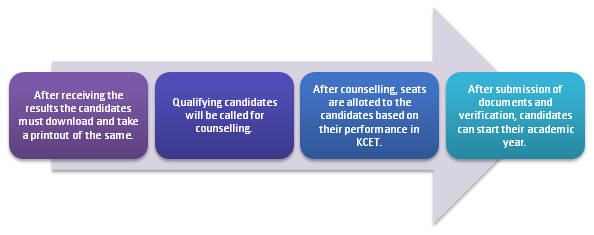
The results of the examination will be available on the official website. Candidates can check their entrance test results by entering the roll number from the official website of the examination. TS ECET result will be merit-based and according to the rank secured by the candidates.
After the declaration of TS ECET results, the Telangana engineering admission of counselling 2018 will be conducted. The candidates have to register for the counselling session after successfully clearing/passing the TS ECET. The qualified candidates will be called for counselling as per their performance in the examination and preferences given in the online application form.
During the counselling session, it is important for the candidates to carry certain documents like that TS ECET admit card, TS ECET hall ticket or admit card, rank card, Aadhar card, 10th and 12thmarksheet, diploma or degree certificates and mark sheets, transfer certificate, domicile certificate of Telangana or Andhra Pradesh state.
List of courses that the candidates can choose for admission are as follows:
| ANE | Aeronautical Engineering |
| ASE | Aerospace Engineering |
| AUT | Automobile Engineering |
| BIO | Bio-Technology |
| BME | Bio-Medical Engineering |
| CEE | Civil and Environmental Engineering |
| CER | Chemical (Ceramic) Technology |
| CHE | Chemical Engineering |
| CIV | Civil Engineering |
| CPE | Chemical Petro Engineering |
| CSE | Computer Science and Engineering |
| CSS | Computer Science and Systems Engineering |
| CST | Computer Science and Technology |
| CVT | Civil Technology |
| ECE | Electronics and Communication Engineering |
| ECM | Electronics and Computer Engineering |
| ECS | Electronics Control Systems Engineering |
| EEE | Electrical and Electronics Engineering |
| EIE | Electronics and Instrumentation Engineering |
| ETC | Electronics and Telecommunication Engineering. |
| ETM | Electronics and Telematics |
| GIN | Geo-Informatics |
| ICE | Instrumentation and Control Engineering |
| INF | Information Technology |
| IPE | Industrial Production Engineering |
| IST | Instrumentation Engineering and Technology |
| MCT | Mechanical (Mechatronics) Engineering |
| MEC | Mechanical Engineering |
| MET | Metallurgical Engineering |
| MIN | Mining Engineering |
| MME | Mining Machinery Engineering |
| MMT | Metallurgy and Material Engineering |
Notification
The notification for Telangana state engineering common entrance test (TS ECET) 2018 for admission of candidates to B.Tech lateral entry and Bachelor in Pharmacy course. It is conducted by JNTU, Hyderabad on behalf of Telangana state Council of higher education. The notification is published on the official site of the exam by first week of March 2018.
Syllabus
The number of subjects varies from the type of course the candidate opts. Engineering consists of 4 subjects, B.Sc mathematics contains three subjects, and Bachelor in pharmacy has three subjects. The common subjects are mathematics, chemistry, and physics.
TS ECET syllabus for different courses and streams are as follows:
Syllabus of the common 3 subjects are as follows:
| MATHEMATICS | CHEMISTRY | PHYSICS |
| Trigonometry | Atomic Structure | Work, Power, and Energy |
| Differential Equations | Acids, Bases & Solutions | Heat & Thermodynamics |
| Matrices | Water Technology | Modern Physics |
| Differentiation & Integration | Chemical Bonding | Simple Harmonic motion & Acoustics |
| Analytical Geometry | Fuels | Kinematics and Friction |
| Complex Numbers | Environmental chemistry | Elements of Vectors |
| Polymers | Units and Dimensions | |
| Water Technology | ||
| Electrochemistry |
TS ECET Mechanical Engineering Syllabus
| 1. | Automobile Engineering |
| 2. | Thermodynamics |
| 3. | Workshop Technology |
| 4. | Refrigeration |
| 5. | Steam Boilers, Turbines & Nozzles |
| 6. | Design of Machine Elements |
| 7. | Engineering Materials & Solid Mechanics |
| 8. | Welding, Forging, Foundry and Conventions in drawing |
| 9. | Industrial Management and Engineering |
| 10. | Hydraulic Machines and Pneumatics |
TSECET Civil Engineering Syllabus
| 1. | Theory of Structures |
| 2. | Hydraulics |
| 3. | Surveying |
| 4. | Irrigation Engineering |
| 5. | Reinforced Concrete Structures |
| 6. | The strength of Materials. |
TS ECET Electrical and Electronics Engineering Syllabus
| 1. | Basic Electrical Engineering. |
| 2. | A.C And D.C Machines. |
| 3. | Batteries & Measuring Instruments. |
| 4. | A.C. Circuits And Transformers. |
| 5. | Power System Generation & Protection |
| 6. | Basic Electronics and Digital Electronics |
| 7. | Power Electronics |
| 8. | Micro Controller |
| 9. | Electric Traction. |
| 10. | Electrical Estimation. |
TS ECET syllabus for Electronics and Communication Engineering- 2
| 1. | Microcontrollers and Microprocessors. |
| 2. | Audio Video Systems. |
| 3. | Digital Electronics. |
| 4. | Circuit Theory. |
| 5. | Electronic Devices and Circuits. |
| 6. | Industrial and Power Electronics. |
| 7. | Electronic Measuring Instruments. |
| 8. | Advanced Communication Systems. |
| 9. | Communication Systems. |
| 10. | Data Communications and Computer Networks. |
TS ECET Computer Science Engineering Syllabus
| 1. | Java Programming |
| 2. | Object-Oriented Programming Through C++. |
| 3. | C and Data Structures. |
| 4. | Operating Systems. |
| 5. | RDBMS |
| 6. | Computer Networks & Organization |
| 7. | Digital Electronics & Microprocessors |
| 8. | Internet Programming. |
TS ECET Ceramic Technology Syllabus
| 1. | Enamels and Glazes. |
| 2. | Glass Technology. |
| 3. | Cement Technology. |
| 4. | Geology and Mineralogy of Ceramic Raw Materials. |
| 5. | Advanced Ceramics. |
| 6. | Fuels, Furnaces & Pyrometry. |
| 7. | White Ware & Heavy Clay Ware. |
TS ECET Chemical Engineering Syllabus
| 1. | Heat Transfer |
| 2. | Chemical process principles. |
| 3. | Material Technology. |
| 4. | Inorganic Chemical Technology. |
| 5. | Organic Chemical Technology. |
| 6. | Energy Technology & Plant Operation. |
| 7. | Fluid mechanics. |
| 8. | Instrumentation & Process control. |
| 9. | Environmental Studies and Pollution Control Engineering. |
| 10. | Mass Transfer |
| 11. | Mechanical unit operations. |
| 12. | Thermodynamics and Reaction Engineering. |
TS ECET Metallurgical Engineering Syllabus
| 1. | Elementary Principles of Metallurgy. |
| 2. | Fuels, Refractories, and Pyrometry. |
| 3. | Material Testing. |
| 4. | Metallurgical Thermodynamics. |
| 5. | Welding Technology. |
| 6. | Physical Metallurgy. |
| 7. | Mechanical Metallurgy. |
| 8. | Heat Treatment Technology. |
| 9. | Ferrous Extractive Metallurgy. |
| 10. | Non-Ferrous Extractive Metallurgy. |
| 11. | Foundry Technology. |
TS ECET Mining Engineering Syllabus
| 1. | Mining Geology. |
| 2. | Methods of Working – Coal. |
| 3. | Mine Surveying. |
| 4. | Methods of Working Metal. |
| 5. | Mine Environmental Engineering – 1. |
| 6. | Mine Environmental Engineering – 2. |
| 7. | Mining Legislation and Mine Management. |
| 8. | Elements of Mining. |
| 9. | Mining Machinery – 1. |
| 10. | Mining Machinery – 2. |
TS ECET Syllabus for Bio-Technology
| 1. | Bio-Physics. |
| 2. | Genetics and Cell Biology. |
| 3. | Microbiology. |
| 4. | Enzyme Engineering. |
| 5. | Basic Industrial Biotechnology. |
| 6. | Bio-Reactor Engineering. |
| 7. | Molecular Biology – Genetic Engineering. |
| 8. | Plant Bio-Technology. |
| 9. | Bio-Bioinformatics. |
| 10. | Animal Bio-Technology. |
TS ECET Electronics and Instrumentation Engineering Syllabus
| 1. | Electrical Engineering. |
| 2. | Industrial electronics and control engineering. |
| 3. | Electronics. |
| 4. | Digital Electronics. |
| 5. | Electronic Measuring Instruments. |
| 6. | Process Instrumentation. |
| 7. | Process Control. |
| 8. | Communications and Linear IC Applications. |
| 9. | Analytical and Biomedical instrumentation. |
| 10. | Micro controller & PLCs. |
TS ECET Syllabus 2018 for Pharmacy
| Pharmaceutics | Pharmaceutical Chemistry | Pharmacognosy | Pharmacology |
| Pharmaceutics – I. | Pharmaceutical Chemistry – I. | Pharmacognosy. | Health Education |
| Pharmaceutics – II. | Pharmaceutical Chemistry – II. | Pharmacology and Toxicology. | Human Anatomy & Physiology. |
| Pharmaceutical Jurisprudence. | Biochemistry and Clinical Pathology. | Drug Store & Business Management. | Community Pharmacy subjects |
| e- | – | Hospital Pharmacy & Clinical Pharmacy. | – |
TS ECET Syllabus for B.Sc
| Mathematics | Analytical Ability | Communicative English Syllabus |
| First Order &First-degree Differential Equations | Coding & Decoding Problems | Vocabulary |
| Higher-Order Linear Differential Equations. | Data Sufficiency. | Grammar |
| Permutation |

